<!DOCTYPE HTML PUBLIC "-//IETF//DTD HTML//EN">
<html>

<head>
<meta http-equiv="Content-Type"
content="text/html; charset=iso-8859-1">
<meta name="GENERATOR" content="Microsoft FrontPage 2.0">
<title>Tables</title>
</head>

<body bgcolor="#FFFFFF">

<table border="0" width="100%">
    <tr>
        <td><font size="6"><strong>Tables</strong></font></td>
        <td align="right"><a href="list.html"><img
        src="../image/previous.gif" alt="Previous" border="0"
        width="40" height="40"></a><a href="set.html"><img
        src="../image/next.gif" alt="Next" border="0" width="40"
        height="40"></a></td>
    </tr>
</table>

<hr size="1">

<p align="center"><!--webbot bot="ImageMap" startspan
rectangle=" (227,318) (399, 348)  flatshort/ds_multiarrayed_hash_table.html"
rectangle=" (60,318) (158, 349)  flatshort/ds_hash_table.html"
rectangle=" (218,242) (406, 273)  flatshort/ds_multiarrayed_sparse_table.html"
rectangle=" (29,242) (189, 274)  flatshort/ds_arrayed_sparse_table.html"
rectangle=" (141,167) (262, 198)  flatshort/ds_sparse_table.html"
rectangle=" (279,93) (367, 124)  flatshort/ds_resizable.html"
rectangle=" (158,93) (247, 124)  flatshort/ds_bilinear.html"
rectangle=" (41,91) (127, 123)  flatshort/ds_table.html"
rectangle=" (36,18) (130, 49)  flatshort/ds_container.html"
src="image/table.gif" border="0" width="451" height="374" --><MAP NAME="FrontPageMap0"><AREA SHAPE="RECT" COORDS="227, 318, 399, 348" HREF="flatshort/ds_multiarrayed_hash_table.html"><AREA SHAPE="RECT" COORDS="60, 318, 158, 349" HREF="flatshort/ds_hash_table.html"><AREA SHAPE="RECT" COORDS="218, 242, 406, 273" HREF="flatshort/ds_multiarrayed_sparse_table.html"><AREA SHAPE="RECT" COORDS="29, 242, 189, 274" HREF="flatshort/ds_arrayed_sparse_table.html"><AREA SHAPE="RECT" COORDS="141, 167, 262, 198" HREF="flatshort/ds_sparse_table.html"><AREA SHAPE="RECT" COORDS="279, 93, 367, 124" HREF="flatshort/ds_resizable.html"><AREA SHAPE="RECT" COORDS="158, 93, 247, 124" HREF="flatshort/ds_bilinear.html"><AREA SHAPE="RECT" COORDS="41, 91, 127, 123" HREF="flatshort/ds_table.html"><AREA SHAPE="RECT" COORDS="36, 18, 130, 49" HREF="flatshort/ds_container.html"></MAP><img src="image/table.gif" border="0" width="451" height="374" usemap="#FrontPageMap0"><!--webbot
bot="ImageMap" i-checksum="43993" endspan --></p>

<h2>Class <em><tt>DS_TABLE</tt></em></h2>

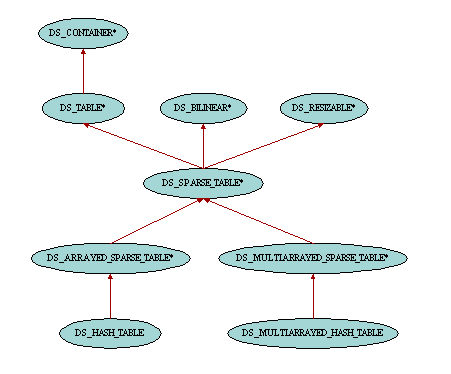
<p>Tables are data structures whose items are accessible by keys.
Therefore the class <a href="flatshort/ds_table.html"><font
color="#008080"><em><tt>DS_TABLE</tt></em></font></a> has two
generic parameters. As for all other container classes, the first
parameter <font color="#008080"><em><tt>G </tt></em></font>represents
the type of the items, whereas the second parameter <font
color="#008080"><em><tt>K</tt></em></font> is the type of the
keys which are associated with the items. The features provided
by class <font color="#008080"><em><tt>DS_TABLE </tt></em></font>are
very similar to some of those of class <a
href="container.html#DS_INDEXABLE"><font color="#008080"><em><tt>DS_INDEXABLE</tt></em></font></a>.
The difference comes from the fact that in <font color="#008080"><em><tt>DS_INDEXABLE
</tt></em></font>keys are contiguous integers whereas in <font
color="#008080"><em><tt>DS_TABLE </tt></em></font>keys can be of
any type, and hence not necessarily contiguous. The main features
introduced in class <font color="#008080"><em><tt>DS_TABLE </tt></em></font>are
<a href="flatshort/ds_table.html#item"><font color="#008080"><em><tt>item</tt></em></font></a><font
color="#008080"><em><tt> </tt></em></font>to access items by key,
<a href="flatshort/ds_table.html#put"><font color="#008080"><em><tt>put</tt></em></font></a>
to insert new items and <a href="flatshort/ds_table.html#replace"><font
color="#008080"><em><tt>replace</tt></em></font></a> to associate
an existing key with another item, <a
href="flatshort/ds_table.html#remove"><font color="#008080"><em><tt>remove</tt></em></font></a>
to remove an item and its associated key from the table, <a
href="flatshort/ds_table.html#valid_key"><font color="#008080"><em><tt>valid_key</tt></em></font></a>
to check whether a key can be used in the table and <a
href="flatshort/ds_table.html#has"><font color="#008080"><em><tt>has</tt></em></font></a>
to check whether an item has already been inserted in the table
with a given key.</p>

<h2>Class <a name="DS_HASH_TABLE"><em><tt>DS_HASH_TABLE</tt></em></a></h2>

<p>One possible implementation of tables is hash tables. A hash
table is typically made up of an array where items are accessed
by integer index. Therefore the keys used in the hash tables
should provide a means to yield such integer value through a
hashing mechanism. This is exactly what feature <font
color="#008080"><em><tt>hash_code</tt></em></font> from <font
color="#008080"><em><tt>HASHABLE</tt></em></font> is for, and
therefore the second generic parameter of <a
href="flatshort/ds_hash_table.html"><font color="#008080"><em><tt>DS_HASH_TABLE</tt></em></font></a>
is constrained by <font color="#008080"><em><tt>HASHABLE</tt></em></font>.
Thanks to this implementation, features of hash tables are
usually more efficient than linked implementations since access
time in an array is bounded by a constant regardless of the
number of items in the container. However the hash code
associated with the keys is not necessarily unique, and therefore
collisions may happen and hence slow down the process. The
efficiency of hash tables hence depends on the number of
collisions that may occur in the table. Therefore the
implementation for the <font color="#008080"><em><tt>hash_code</tt></em></font>
of the keys is very important since returning often the same
value for different keys will trigger too many collisions and
yield performance degradations. If the default implementation of <font
color="#008080"><em><tt>hash_code </tt></em></font>is not optimal
for a given set of keys, one can inherit from <font
color="#008080"><em><tt>DS_HASH_TABLE </tt></em></font>and
redefine its feature <font color="#008080"><em><tt>hash_position </tt></em></font>to
provide a better implementation. For example, consider a school
which keeps track of project assignments in a table indexed by
students. The obvious solution is to declare:</p>

<blockquote>
    <pre><em>assignments</em>: <em>DS_HASH_TABLE</em> [<em>PROJECT</em>, <em>STUDENT</em>]</pre>
</blockquote>

<p>However the implementation of <font color="#008080"><em><tt>hash_code
</tt></em></font>in class <font color="#008080"><em><tt>STUDENT</tt></em></font>
inherited from <font color="#008080"><em><tt>PERSON</tt></em></font>
just returns the age of the person. This implementation of <font
color="#008080"><em><tt>hash_code</tt></em></font> in class <font
color="#008080"><em><tt>PERSON</tt></em></font> is perfectly
valid in most cases, but it is clear that when dealing with
students in the same classroom it is likely that they will all
have more or less the same age and hence the same hash code. In
this particular case it is better to provide a better
implementation for <font color="#008080"><em><tt>hash_position </tt></em></font>in
<font color="#008080"><em><tt>DS_HASH_TABLE </tt></em></font>to
avoid the numerous collisions:</p>

<blockquote>
    <pre><font color="#000080"><em><strong>class</strong></em></font><em> ASSIGNMENTS
</em><font color="#000080"><em><strong>inherit</strong></em></font><em>
    DS_HASH_TABLE </em>[<em>PROJECT</em>,<em> STUDENT</em>]<em>
        </em><font color="#000080"><em><strong>redefine</strong></em></font><em>
            hash_position
        </em><font color="#000080"><em><strong>end
create</strong></em></font><em>
    make
</em><font color="#000080"><em><strong>feature</strong></em></font><em> </em>{<em>NONE</em>} <font
color="#008000">-- Implementation</font><em>
    hash_position </em>(<em>s</em>:<em> STUDENT</em>):<em> INTEGER </em><font
color="#000080"><em><strong>is</strong></em></font><em>
            </em><font color="#008000">-- Hash position of student</font> <em>s</em><font
color="#008000"> in internal array</font><em>
        </em><font color="#000080"><em><strong>do</strong></em></font><em>
            </em><font color="#000080"><em><strong>if</strong></em></font><em> s </em>/=<em> </em><font
color="#008080"><em>Void</em></font><em> </em><font
color="#000080"><em><strong>then</strong></em></font><em>
                </em><font color="#008080"><em>Result</em></font><em> </em>:=<em> s</em>.<em>name</em>.<em>hash_code </em>\\<em> modulus
            </em><font color="#000080"><em><strong>else</strong></em></font><em>
                </em><font color="#008080"><em>Result</em></font><em> </em>:=<em> modulus
            </em><font color="#000080"><em><strong>end</strong></em></font><em>
        </em><font color="#000080"><em><strong>end
end</strong></em></font><em> </em></pre>
</blockquote>

<p>The keys are directly stored in the hash table without being
copied. Therefore it is important that the hash code associated
with each key doesn't change while the key is stored in the hash
table. Otherwise the hashing mechanism would be broken and it
would be impossible to access the item associated with this key.
Likewise, keys are compared in the hash table using the feature <a
href="flatshort/ds_hash_table.html#key_equality_tester"><font
color="#008080"><em><tt>key_equality_tester</tt></em></font></a>
of type <a href="flatshort/ds_equality_tester.html"><font
color="#008080"><em><tt>DS_EQUALITY_TESTER</tt></em></font></a>.
Therefore if the critera used to implement the function <a
href="flatshort/ds_equality_tester.html#test"><font
color="#008080"><em><tt>test</tt></em></font></a><font
color="#008080"><em><tt> </tt></em></font>in <font
color="#008080"><em><tt>DS_EQUALITY_TESTER </tt></em></font>are
changed while the key is stored in the hash table, this key might
not be recognized properly anymore within this hash table.
Needless to say that if two keys are considered equal, they
should have the same hash code. The solution when the hash code
or equality criteria of a key are likely to vary while the key is
stored in the hash table is to clone that key when inserting an item
associated with it.</p>

<p>The class <font color="#008080"><em><tt>DS_HASH_TABLE </tt></em></font>provides
traversal facilities inherited from <a
href="traversal.html#DS_BILINEAR"><font color="#008080"><em><tt>DS_BILINEAR</tt></em></font></a>.
Although all items will be visited once and only once during a
traversal, they will be traversed in an unpredictable order and
subsequent traversals may traverse the items in different orders.
This is because a hash table is not an ordered container as can
a list be. Items are not inserted before or after other items in
the hash table but based on a hashing mechanism and
collision-resolution algorithm. The only way to get a guaranteed
ordered hash table with the current implementation is to use
exclusively feature <a
href="flatshort/ds_hash_table.html#force_last"><font
color="#008080"><em><tt>force_last</tt></em></font></a> to insert
items.</p>

<p>As you may now realize after reading the first paragraph
above, the performance of hash tables is one of their <em>raison
d'être</em>. This had of course to be taken into account when
implementing the routines inherited from <font color="#008080"><em><tt>DS_TABLE</tt></em></font>.
Because of the precondition of <a
href="flatshort/ds_hash_table.html#item"><font color="#008080"><em><tt>item</tt></em></font></a>
which states that in order to be able to query an item associated
with a given key, that item has to exist in the first place, one
has to write:</p>

<blockquote>
    <pre><font color="#000080"><em><strong>if</strong></em></font><em> table</em>.<em>has </em>(<em>k</em>)<em> </em><font
color="#000080"><em><strong>then</strong></em></font><em>
    v </em>:= <em>table</em>.<em>item </em>(<em>k</em>)<em>
</em><font color="#000080"><em><strong>else</strong></em></font><em>
    ...
</em><font color="#000080"><em><strong>end</strong></em></font></pre>
</blockquote>

<p>However, both <a href="flatshort/ds_hash_table.html#has"><font
color="#008080"><em><tt>has</tt></em></font></a><font
color="#008080"><em><tt> </tt></em></font>and <a
href="flatshort/ds_hash_table.html#item"><font color="#008080"><em><tt>item</tt></em></font></a><font
color="#008080"><em><tt> </tt></em></font>will have to compute
the hash code of <font color="#008080"><em><tt>k</tt></em></font>
and deal with possible collisions in the hash table. In other
words we do twice the same thing. The solution adopted in the
current implementation of <font color="#008080"><em><tt>DS_HASH_TABLE
</tt></em></font>is to keep track of the result of the last
hashing operation in the hash table in a cache. Therefore, in the
code above, most of the work of accessing the item at key <font
color="#008080"><em><tt>k</tt></em></font> will be done only once
in the routine <font color="#008080"><em><tt>has</tt></em></font>,
and <font color="#008080"><em><tt>item </tt></em></font>will
realize that the key given as argument is the same and hence
avoid calling the hashing mechanism again.</p>

<p>Another solution to avoid that would have been to get rid of
the precondition in <font color="#008080"><em><tt>item </tt></em></font>and
return <font color="#008080"><em><tt>Void</tt></em></font> when
there is no item associated with key <font color="#008080"><em><tt>k</tt></em></font>.
However this solution goes against the principle of <em>Design by
Contract</em> since getting <font color="#008080"><em><tt>Void</tt></em></font>
could either mean that there is no item for key <font
color="#008080"><em><tt>k</tt></em></font> or that there is
actually one which happens to be <font color="#008080"><em><tt>Void</tt></em></font>.
Therefore this solution has not been adopted in <font
color="#008080"><em><tt>DS_HASH_TABLE </tt></em></font>but a
better designed alternative also based on the <em>try-and-see</em>
principle is available:</p>

<blockquote>
    <pre><em>table</em>.<em>search </em>(<em>k</em>)
<font color="#000080"><em><strong>if</strong></em></font><em> table</em>.<em>found </em><font
color="#000080"><em><strong>then</strong></em></font><em>
    v </em>:= <em>table</em>.<em>found_item
</em><font color="#000080"><em><strong>else</strong></em></font><em>
    ...
</em><font color="#000080"><em><strong>end</strong></em></font></pre>
</blockquote>

<p>Both code excerpts should have the same execution time
performance thanks to <font color="#008080"><em><tt>DS_HASH_TABLE</tt></em></font>'s
internal optimizations. Using one or the other is just a question
of taste.</p>

<h2>Class <em><tt>DS_MULTIARRAYED_HASH_TABLE</tt></em></h2>

<p>When hash tables contain a very large number of items, the
implementation of <font color="#008080"><em><tt>DS_HASH_TABLE </tt></em></font>may
reach some limits since the internal arrays become too huge and
resizing them may yield memory problems. The class <a
href="flatshort/ds_multiarrayed_hash_table.html"><font
color="#008080"><em><tt>DS_MULTIARRAYED_HASH_TABLE</tt></em></font></a><font
color="#008080"><em><tt> </tt></em></font>provides the same
functionalities as <font color="#008080"><em><tt>DS_HASH_TABLE </tt></em></font>but
uses a sequence of fixed size arrays instead of a single array
for its implementation. These array chunks are only created when
first accessed and resizing the whole table does only require to
add one or several chunks to the sequence and therefore avoids
having to resize big arrays.</p>

<hr size="1">

<table border="0" width="100%">
    <tr>
        <td><address>
            <font size="2"><b>Copyright © 2000-2005</b></font><font
            size="1"><b>, </b></font><font size="2"><strong>Eric
            Bezault</strong></font><strong> </strong><font
            size="2"><br>
            <strong>mailto:</strong></font><a
            href="mailto:ericb@gobosoft.com"><font size="2">ericb@gobosoft.com</font></a><font
            size="2"><br>
            <strong>http:</strong></font><a
            href="http://www.gobosoft.com"><font size="2">//www.gobosoft.com</font></a><font
            size="2"><br>
            <strong>Last Updated:</strong> 13 February 2005</font><br>
            <!--webbot bot="PurpleText"
            preview="
$Date$ 
$Revision$"
            --> 
        </address>
        </td>
        <td align="right" valign="top"><a
        href="http://www.gobosoft.com"><img
        src="../image/home.gif" alt="Home" border="0" width="40"
        height="40"></a><a href="index.html"><img
        src="../image/toc.gif" alt="Toc" border="0" width="40"
        height="40"></a><a href="list.html"><img
        src="../image/previous.gif" alt="Previous" border="0"
        width="40" height="40"></a><a href="set.html"><img
        src="../image/next.gif" alt="Next" border="0" width="40"
        height="40"></a></td>
    </tr>
</table>
</body>
</html>
